Though not long enough to be depressing Satantango is ultimately a brooding danse macabre through the dark side of the human spirit with appropriately placed humor. Realistic enough to strike fear into your heart while, at the edge of vision and hearing something stirs: possibly supernatural, perhaps just the wind... Shows hints of Peake, Tarkovsky, and was appropriately made into a SEVEN HOUR FILM by Bela Tarr. Satantango presents a view of Hungarian country life that is anything but pastoral. Krasnahorkai is skilled at creating and maintaining a sense of impending catastrophe while relegating activity, for the most part, to bar conversations, drunken walks and sullen contemplation. The End appears to always be at arms length, ever approaching. Yet it never arrives.
The Hungarian fruit brandy palinka is the central character of the novel and easily gets the most pagetime in the book. The rest of the plot follows a sad sack group of practically interchangeable peasant couples eking out a horrid existence on a defunct farm estate who spend their time drinking, fighting, fucking each other's wives and ignoring their own. On the periphery are an observer: a doctor with easily the strongest alcohol addiction, his days a jumble of passing out in the street, recording meticulous details of the estate and mentally disparaging the other villagers, and an innocent: an apparently retarded little girl from a broken and abusive house who lives in her own perfect world. Each are separate from the village in their own way yet are caught in the grasp of despair which penetrates, the only human casualties of the malaise which lays over the town. Depending on the situation certain characters are portrayed in very different ways. The "savior" Irimias at first appears dimwitted in a police station yet becomes godlike when among his followers, a boy is callous and controlling to his younger sister yet is later controlled by Irimias. This can be a little off putting (we want consistency in our characters after all) yet is accurately portrays the subjectivity of identity.
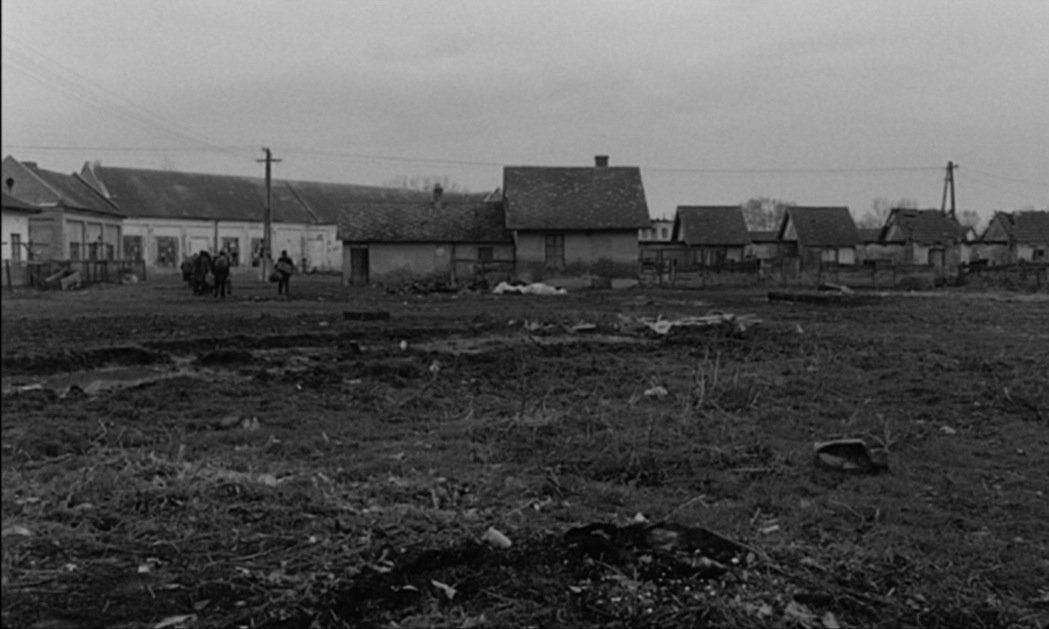
The central event of the work is the return of a sort of savior who makes grandiose promises and leads the villagers, divided for and against him, "out" of the estate and into perhaps greener pastures. Immediately after leaving the estate they return to their old ways. It's very clear that their destructive behavior is entirely self determined, the savior only stands as a symbol really, the villagers are capable the whole time of making their lives better but choosing to remain in despair while blaming it on outside forces. Krasnahorkai's view of human nature is dark but optimistic: we are often condemned to pain and stagnation but it is ultimately our choice whether to attribute outside of ourselves and remain or find the source inside ourselves and become liberated.
For a novel of this type the narrative is relatively straight forward: this isn't a difficult novel, nor long. Some parts are a little disjointed, and the story follows the back and forth, recursive steps of the tango: there is no beginning or end, we see the same events and characters from different angles and they are altered appropriately. Unusual, supernatural events occur: bar patrons drunkenly fall asleep and are almost instantly covered in spider webs, a little girl is whisked away into the sky by a chorus of ghostly humms. None of these are uplifting or "magical" in the way of Marquez or H. Murakami and very well may be hallucination. Perhaps Satantango could be accurately listed as "cursed realism".
Tuesday, August 14, 2012
Tuesday, August 7, 2012
Monday, August 6, 2012
Review: "Anatomy Courses" by Blake Butler and Sean Kikpatrick
Well for starters this book is fucking horrifying. The subject matter, style and presentation are all completely antithetical to all the tenets of good taste and aesthetic value. It is pure, undiluted Transgressive fiction in both form and content. It reminds me in more than one way of the literary equivalent of Grindcore: the book comes off as raw, uncompromising, and obscene. I'm not sure what the level and nature of Butler and Kilpatrick's collaboration on the work was but Anatomy Courses seems to be lean further toward Kilpatrick's style than Butler's. The writing is heavily fragmented in places (not so much in others) and I found myself wondering time and again whether the cut-up technique was used, though in retrospect I suspect not.
The general lay out of the book is a series of short chapters that are mostly told in the first person from an unknown narrator. It seems to follow a family made up of a (or "the") Father, the Mother and at various points a baby or a daughter. Common topics include implied pedophilia, broom rape, fisting, colostomy bags pyramids, etc. In the beginning I attempted to glean a narrative from the work but over time this became so frustrating and difficult that I just started reading it out loud, not caring about potential connections between events or finding a coherent voice, the disconnected words simply flowing together. It was only after I did this that, believe it or not, Anatomy Courses became very beautiful. Whether through design or accident Butler and Kilpatrick have introduced a subtle but very lovely poetry in the chapters and, if you can get over that these sounds, when interpreted have meanings which are pretty nasty, Anatomy Courses is a poetic work of high caliber. The odd juxtapositions of highly charged images provide the sort of ubermeanings similar to that found in Thomas's iconic poems. There is a certain dissonance in the sounds and often the authors seem to set up a pattern or series of sounds then cut it off midway simply for the jarring effect as in
"The infant kissed the ground. Its heart pooled up between its shoulders, cussing maiden love of mine I'd made to mimes and sent to goose the streets for softcore"(65). He gets those "M"'s going and going and going then they just stop, and you are left there hanging with those weird "S"'s. Like a symphony which never returns to its first key there is a structural transgression to Anatomy Courses.
Anatomy Courses and the recently reviewed One Hour of Television share a number of traits and it was interesting to read them concurrently. Both are experimental and at least give the illusion of a narrative while allowing apparently unrelated material to take up a large part of their respective works. Both Butler and Kilpatrick are widely published and have great blogs, Kilpatrick's being slightly more terrifying that Butler's but has a bunch of really well done interviews with a range of alt-lit writers which are definitely worth a read. His videos have a Throbbing Gristle vibe which I like a lot but probably appeals to a slim audience. Reader beware.
The general lay out of the book is a series of short chapters that are mostly told in the first person from an unknown narrator. It seems to follow a family made up of a (or "the") Father, the Mother and at various points a baby or a daughter. Common topics include implied pedophilia, broom rape, fisting, colostomy bags pyramids, etc. In the beginning I attempted to glean a narrative from the work but over time this became so frustrating and difficult that I just started reading it out loud, not caring about potential connections between events or finding a coherent voice, the disconnected words simply flowing together. It was only after I did this that, believe it or not, Anatomy Courses became very beautiful. Whether through design or accident Butler and Kilpatrick have introduced a subtle but very lovely poetry in the chapters and, if you can get over that these sounds, when interpreted have meanings which are pretty nasty, Anatomy Courses is a poetic work of high caliber. The odd juxtapositions of highly charged images provide the sort of ubermeanings similar to that found in Thomas's iconic poems. There is a certain dissonance in the sounds and often the authors seem to set up a pattern or series of sounds then cut it off midway simply for the jarring effect as in
"The infant kissed the ground. Its heart pooled up between its shoulders, cussing maiden love of mine I'd made to mimes and sent to goose the streets for softcore"(65). He gets those "M"'s going and going and going then they just stop, and you are left there hanging with those weird "S"'s. Like a symphony which never returns to its first key there is a structural transgression to Anatomy Courses.
Anatomy Courses and the recently reviewed One Hour of Television share a number of traits and it was interesting to read them concurrently. Both are experimental and at least give the illusion of a narrative while allowing apparently unrelated material to take up a large part of their respective works. Both Butler and Kilpatrick are widely published and have great blogs, Kilpatrick's being slightly more terrifying that Butler's but has a bunch of really well done interviews with a range of alt-lit writers which are definitely worth a read. His videos have a Throbbing Gristle vibe which I like a lot but probably appeals to a slim audience. Reader beware.
Sunday, August 5, 2012
One poem
holy promises written in the sand
laissez-faire information has backfired
with blue screens in ubiquity
a taste for theft and memes acquired
everyone's got their drug of choice
that's not a secret they are keeping from you
it's how you use it
and what you lose in the process
that's got shit tied up
and i'm stepping on gravestones
a good solid footing after the
sucking mud. It's the stereotypes
that pull me down, the mire
and blindness of generalization. In
this hazelnut orchard: where
the meat falls an epitaph rises
laissez-faire information has backfired
with blue screens in ubiquity
a taste for theft and memes acquired
everyone's got their drug of choice
that's not a secret they are keeping from you
it's how you use it
and what you lose in the process
that's got shit tied up
and i'm stepping on gravestones
a good solid footing after the
sucking mud. It's the stereotypes
that pull me down, the mire
and blindness of generalization. In
this hazelnut orchard: where
the meat falls an epitaph rises
Friday, August 3, 2012
Tuesday, July 31, 2012
City on a Hill (The story of Keely)
The story of Keely. Sweet sad Keely. Artist and observer this one red heared and sad eyed she was; no, later, sapped of strength: a simple husk. Girl of a thousand cities, a dozen men: none fathers. A traveler when young, a wanderer by luck, not will. Of a half moon woman born. This woman, this mother also a shattered soul, but a wanderer by necessity. Cigarette smoking at six am in the lemon balm sunrise of Yakima in the summer. Sitting, staring in the driver's seat of her secondhand red pickup eyes hard and cautious. Keely, young, curled in the front seat under a heap of blankets either too rough or too soft. Blankets smelling of soot, sweat or industrial detergent. Moving in and out of halfsleep for hours and hours. Always a sensitive nose on this Keely. Could smell fear as a rough animal undertone, love like a woody warmth. This was a curse in the diners and doublewides of her youth. Ammonia a swarm of chemical bees which stung her eyes. The scent of old beer like heavy stale bread that filled her nose and mouth and made her choke.
Lovely Keely, lithe when older. Skinny, long hair taut to her shoulders. She: taunted.
-Hey Ginger, hear laughs, makes the mistake and bites: turns to face the voice -Dropped your soul! When half grown Keely settles down in body, her soul though only begins its motions. Finds solace in music, in slow sad music and songs meant for those many years older than her. Songs for those who have been dealt the blows of life. Keely herself has been dealt blows, far more blows that one her age should know. Each move ripped out her roots, each night spent asleep in a car or cheap motel chilled her to the bone and drew her in a little more. And the men. The string of father. Changing as often as her homes, some stayed for a year. Most for months, weeks. They ignored her, never gave so much as a glance. Others made her an object: talked about "it" or "that". One hit, one worse.
And the worst? That one was kind, saw what lay deep in Keely, her potential, and brought it out. In all the time past she had learned to read men like an old rancher reads cattle. He brought her out of herself and she bloomed. Breifly. When settled one Christmas she recieved from him a dusty warm sixstring. Her sixshooter. Soon after the mother lost her way, the man lost his patience and so sadly they parted. Keely lost this force; her rock. Thus the most painful man. The mother moved on but always after that Keely kept him in her heart as a small empty space, unfillable by another. The guitar lay sullen and silent in the corner of her closet for almost a year when (as if drawn to it) bored and heartbroken, she picked it up and began to pick childhood songs out of tune. Those two were a perfect match and she found her language in the songs she wrote. Shy for so many years Keely kept her songs inside and the guitar gladly took on some of the scars she held. She pulled words and phrases from its grained skin with a dull brown pocket knife. Painted lilies on the neck and stained the head with flowers and bark which faded over time to a dull mottle. Hours everyday spent in her room added up to a great skill and imagination in song writing. Could tune it by ear in seconds.
Self doubt, that nagging demon, lived in the ferriswheel of her heart, brought to her oscillations of worthlessness which kept the songs hidden for years. Found playing one day outside Steele Commons those few encouraging blushwords brought her to play in front of a crowd for the first time her freshman year. The applause sending surges and ripples unshown through her body. Feeling for the first time an acceptance that filled her soul..
Lovely Keely, lithe when older. Skinny, long hair taut to her shoulders. She: taunted.
-Hey Ginger, hear laughs, makes the mistake and bites: turns to face the voice -Dropped your soul! When half grown Keely settles down in body, her soul though only begins its motions. Finds solace in music, in slow sad music and songs meant for those many years older than her. Songs for those who have been dealt the blows of life. Keely herself has been dealt blows, far more blows that one her age should know. Each move ripped out her roots, each night spent asleep in a car or cheap motel chilled her to the bone and drew her in a little more. And the men. The string of father. Changing as often as her homes, some stayed for a year. Most for months, weeks. They ignored her, never gave so much as a glance. Others made her an object: talked about "it" or "that". One hit, one worse.
And the worst? That one was kind, saw what lay deep in Keely, her potential, and brought it out. In all the time past she had learned to read men like an old rancher reads cattle. He brought her out of herself and she bloomed. Breifly. When settled one Christmas she recieved from him a dusty warm sixstring. Her sixshooter. Soon after the mother lost her way, the man lost his patience and so sadly they parted. Keely lost this force; her rock. Thus the most painful man. The mother moved on but always after that Keely kept him in her heart as a small empty space, unfillable by another. The guitar lay sullen and silent in the corner of her closet for almost a year when (as if drawn to it) bored and heartbroken, she picked it up and began to pick childhood songs out of tune. Those two were a perfect match and she found her language in the songs she wrote. Shy for so many years Keely kept her songs inside and the guitar gladly took on some of the scars she held. She pulled words and phrases from its grained skin with a dull brown pocket knife. Painted lilies on the neck and stained the head with flowers and bark which faded over time to a dull mottle. Hours everyday spent in her room added up to a great skill and imagination in song writing. Could tune it by ear in seconds.
Self doubt, that nagging demon, lived in the ferriswheel of her heart, brought to her oscillations of worthlessness which kept the songs hidden for years. Found playing one day outside Steele Commons those few encouraging blushwords brought her to play in front of a crowd for the first time her freshman year. The applause sending surges and ripples unshown through her body. Feeling for the first time an acceptance that filled her soul..
Monday, July 30, 2012
Review: One Hour of Television by Kristine Born
I received a copy of this book for free when I ordered some other books (Nothing and Anatomy Courses both to be reviewed soon) from Blake Butler. So there's that. One hour of Television is 136 pages divided into 3 section, each page a single paragraph of text. Some paragraphs are long, others are short, some more coherent that others. Each paragraph roughly stands alone by itself and many have an unsettling edge as if taken extempore from another work or another world. I would call some of them poems or poetry, but there are no artistic line breaks... So it's prose? I guess? At the very least much of One Hour is poetic. The paragraphs have an aphoristic quality to them and in hindsight One Hour might be as good of a read just picked up and read at random than from cover to cover. Most pages have a surreal flavor or are unusually funny while a few are downright confusing. There is a cohesive story line that picks up a little into the book which relates the tale of the narrator and his friend who steal some money then go to a poker tournament. There is tension between the narrator and his friend over the narrator's wife. Each vignette of the narrative comes a few pages apart however, and i felt that the story line wasn't vitally important to the book as a whole. A major theme touches on nuclear war and cold war era America and actually provide some interesting views on the situation. Born calls out the hypocritical possession of nuclear weapons by a handful of large nations while restricting access to smaller nations, comparing it to the condescending tone of parents arguing in front of their children,
"We have to squat with our hands on our knees so that our face is level with its face and say, This is grown up talk, sweetie. Mommy and Daddy are having a disagreement but they still love each other very much."(29) An astute observation and funny to boot.
If it hasn't been made clear already One Hour of Television is pretty experimental but there are undercurrents and themes here that hold the book together better than a lot of the other experimental works I've read. Born's attention to larger issues (war, national relations, etc.) while far from rigorous is unusual and fresh in literature of this type and provides a certain maturity and wide scope of thought in a genre that is lacking in both of these.
Had a quick look at her blog which unfortunately has not been updated in two years. Which is ironic as she could probably just publish a book out of those blog posts that would receive huge alt-lit attention. Born is young, comes from Vancouver, and is endorsed by both Blake Butler and Dennis Cooper facts which should be shooting up flags all over the place. It looks like she hasn't put anything else since One Hour of Television which is a shame as it is an unusual, intriguing, and original debut.
"We have to squat with our hands on our knees so that our face is level with its face and say, This is grown up talk, sweetie. Mommy and Daddy are having a disagreement but they still love each other very much."(29) An astute observation and funny to boot.
If it hasn't been made clear already One Hour of Television is pretty experimental but there are undercurrents and themes here that hold the book together better than a lot of the other experimental works I've read. Born's attention to larger issues (war, national relations, etc.) while far from rigorous is unusual and fresh in literature of this type and provides a certain maturity and wide scope of thought in a genre that is lacking in both of these.
Had a quick look at her blog which unfortunately has not been updated in two years. Which is ironic as she could probably just publish a book out of those blog posts that would receive huge alt-lit attention. Born is young, comes from Vancouver, and is endorsed by both Blake Butler and Dennis Cooper facts which should be shooting up flags all over the place. It looks like she hasn't put anything else since One Hour of Television which is a shame as it is an unusual, intriguing, and original debut.
Subscribe to:
Posts (Atom)